

Expert:
“What the US Health Care System Assumes about You.” Performance by Mitchell Katz, TED Talks, Nov. 2018, www.ted.com/talks/mitchell_katz_what_the_us_health_care_system_assumes_about_you.
“When our health care systems have the same commitment to low-income patients that that man had to us, two things will happen. First, the system will be responsive to the needs of low-income people. It will speak their language, it will meet their schedules, it will fulfill their needs. Second, we will be providing the kind of care that we went into this profession to do -- not just checking the boxes, but really taking care of those we serve.”
In Katz’s TED talk, he criticizes the American health system and how it bases a middle class view onto their patients. It often passes their mind the circumstances low income patients have and how this affects their ability to keep up with their health. These patients don’t have the same access to things middle class patients would have. This could lead from missing appointments from not having access to transportation to not understanding the conditions due to lack of translators/complicated text. There are many factors that aren’t being addressed and low income patient’s needs aren’t being met. These assumptions based on what the patient can and can’t do may seem miniscule but can be harmful if not met.
This TED talk was really insightful and Katz brought a new perspective through his own experience with patients who didn’t have access to the resources others may have. It really makes me appreciate the privileges I have outside of medical care. It’s disheartening to see that even if health care or insurance is provided to low income patients it still isn’t enough to close the health disparities. Low income patients will still have to worry about a supply of food or even having a home which can affect treatment. I feel like we should encourage more community work because you don’t have to be a doctor to contribute to healthcare or others. This can be working at a foodbank that supplied food to those who need it or fighting for housing where homelessness is prevalent.
Collective Expertise:
Adelman, Larry. Watch UNNATURAL CAUSES: Is Inequality Making Us Sick? Online: Vimeo On Demand. Unnatural Causes, 14 Aug. 2014, vimeo.com/ondemand/unnaturalcauses.
“In America, the wealth health gradient looks like this: Over 70% of affluent American report very good to excellent health – almost twice as many as poor Americans. No surprise. But in the middle levels, good health decreases significantly. This translates into a reverse slope for chronic disease. Diabetes: Low income Americans have twice the rate of disease as the affluent. And for those in the middle, it’s still almost twice the rate. A similar pattern holds for stroke, heart disease, eventually contributing to excess death, especially for middle and low income Americans. “
The documentary was up to rent for about $5 but the transcripts for each episode was free. At the moment I was unable to actually watch the documentary but it is available to buy/rent to anyone. I’m especially appreciative of the free transcript because the information can still be accessible. When reading this it reminds me of how eating healthier and sustainability is always pushed and others are shamed for not having this lifestyle but the reality is, not everyone can live this lifestyle. Eating healthier sadly costs more and not many people have access to fresher foods or even a grocery store close by. This can lead to increased health problems and lifestyle that isn’t as healthy as an affluent person would have. This explains why those who are well off are more likely to live longer, they have consistent access to resources such as fresh food. It puts into perspective how the systems of oppression really do affect all aspects of life and how they all interconnect.
Cultural Piece:
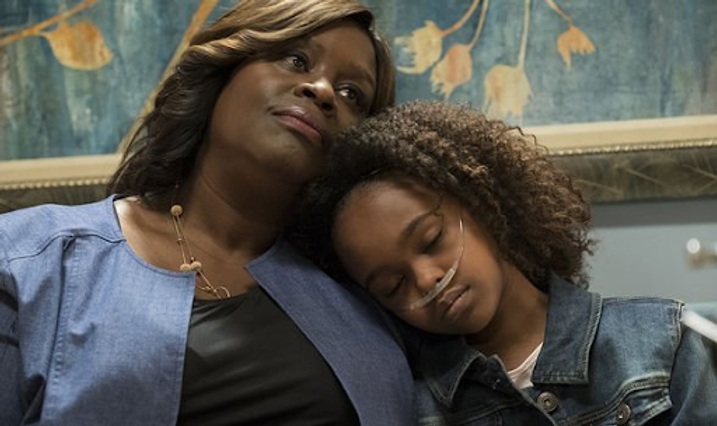
Bans, Jenna. Good Girls. NBC, www.nbc.com/good-girls/episodes.
Unfortunately, I am unable to get the specific clip but here are the timestamps if you are able to access streaming this show. Season:3 Episode:1 timestamp 28:03-30:10
“So you have a sick kid too and your husband works a disgusting, humiliating job that demeans you as a woman and a mother all to pay for something that anybody on planet Earth would expect to be covered?”
I chose this scene from this show because of the character Ruby’s plotline. She has a daughter who has a kidney disease and due to the lack of money she resorted to other ways to get the medicine and kidney transplant her daughter needs to live. In this episode, she questions how it is expected to pay for her daughter to stay alive from a kidney disease that consistently needs to be medicated. This is the sad reality of many low-income Americans. Something common would be insulin for diabetes. Each vial of insulin can range from hundreds of dollars and not everyone can afford it. Not only that not everyone has the refrigeration needed for insulin or even a home. There is treatment but the access for treatment is limited to those who have the money. There are people who rely on treatments to simply just live but this isn’t something that is covered. You have to pay for your own life as if it’s not your own human right.

Community Resource:
“UNNATURAL CAUSES: CALIFORNIA NEWSREEL.” UNNATURAL CAUSES | CALIFORNIA NEWSREEL, unnaturalcauses.org/.
"Think for a moment of poverty as a disease, thwarting growth and development, robbing children of the healthy, happy futures they might otherwise expect. In the exam room, we try to mitigate the pain and suffering that are its pernicious symptoms. But our patients’ well-being depends on more, on public health measures and prevention that lift the darkness so all children can grow toward the light." - Blog post by Dr. Perri Klass at the New York Times "Well" blog
This is the same website the documentary I mentioned earlier, Unnatural Causes, is on and I listed this website because besides the documentary they also have a lot of resources surrounding the issue of health disparities. They have a bunch of media and documents listed on the websites from transcripts to their documentaries, campaigns, interviews with scholars, and graphics. Not only do they focus on health inequality but also provide other films that focus on social justice such as Race: The Power of an Illusion. I included this website twice in this portion of my project because it was incredibly helpful towards the research for this project. One transcript alone was full of so much information and this online resource had many other resources to access. I would like to thank my mentor for recommending this documentary/online resource. Even though this was made in 2014 the information still holds true to this day.

Current News:
Chávez, Lydia. “The Covid-19 Warriors at UCSF Are Often Female, Always Fierce and Unusually Diverse.” Mission Local, 13 Mar. 2021, missionlocal.org.
Illustration by Molly Oleson
“As we’re all addressing inequities it’s really important to have people of color, women of color, at the table and shaping this work.”
As dealing with Covid-19 has been our reality for over a year now it is something that we think about everyday. However, Covid is impacting marginalized communities. It's the same thing as voting, the richer people are able to take days off from work or in this case stay home while lower income families still have to work to make ends meet. The lack of resources goes to this cause as well such as access to clean water. Often they can be harder to reach therefore harder to get treated.
My mentor had recommended I read this article and I really resonated with it. I believe there should be more doctors and physicians of color because there’s a chance they’ll have a background of the disparities present in the system. Representation in any field is so important especially when it comes to acknowledging oppressions within respective marginalized groups.